Installation
The Reemo Agent is the software to install on your remote computers in order to enable remote access via the Reemo web interface. Once installed and configured with your Personal Key or Studio Key, the computer will automatically appear in your portal.
On Windows, installation is done in a few simple steps:
Download the installer from: https://reemo.io/download/
Run the downloaded .exe file.
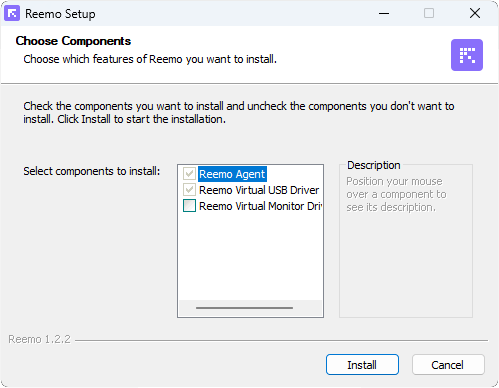
Follow the instructions displayed by the setup wizard.
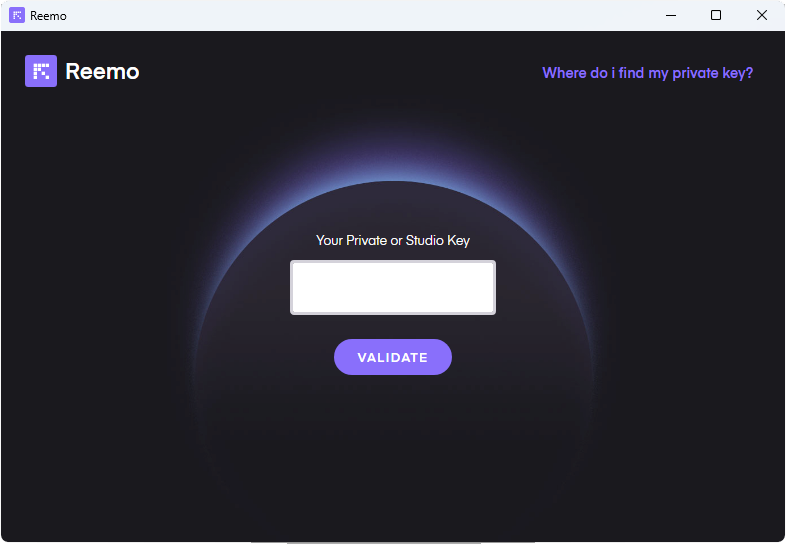
Enter your Personal Key or Studio Key to link this computer to your account or organization.
Once the installation is complete, the agent starts automatically in the background.
Important
The Personal Key or Studio Key is required to link the machine to your account or organization.
During installation, there is an option to enable the Reemo Virtual Monitor Driver. If you want to use the virtual display feature, make sure to check this box before completing the installation.
Silent Installation
Silent installation allows you to install the Reemo Agent without a user interface, ideal for automated or large-scale deployments.
set studio_key=<PRIVATE_KEY>
set signal_server=<SIGNAL_SERVER>
md "C:\Program Files\Reemo"
powershell Invoke-WebRequest 'https://download.reemo.io/reemo.setup.x64.exe' -OutFile 'C:\Program Files\Reemo\reemo.setup.x64.exe'
"C:\Program Files\Reemo\reemo.setup.x64.exe" /S /SECRETKEY="%studio_key%" /SERVER="%signal_server%"
Note
- Silent installation options:
/S : Launches the installation in silent mode (no user interface).
/SECRETKEY : Specifies the Personal Key or Studio Key directly in the command.
/SERVER : Specifies the custom signaling server address in the format “server:port”.
/SUPPORT : Enables support mode at install time — see Reemo Support.
On Linux, the agent can be installed directly from the terminal, depending on your distribution.
Note
Current versions only support capture through X.Org Server.
You must have administrative (sudoer) rights to install the agent.
Debian Based (Ubuntu, Debian, etc.) (64-bit)
curl -sL -o /tmp/reemo.x 'https://download.reemo.io/linux/deb/setup.x'
sudo bash /tmp/reemo.x
Fedora (64-bit)
curl -sL -o /tmp/reemo.x 'https://download.reemo.io/linux/rpm/setup.x'
sudo bash /tmp/reemo.x
Arch Linux (64-bit)
curl -sL -o /tmp/reemo.x 'https://download.reemo.io/linux/arch/setup.x'
sudo bash /tmp/reemo.x
Note
- Installation options:
Interactive installation: Without options, the script will ask you to enter your Personal Key or Studio Key directly in the terminal during installation.
--key : Allows you to specify your Personal Key or Studio Key directly in the command line to avoid interactive entry.
--server : Allows you to specify the address of your custom signaling server for private cloud deployments.
--no-usb : Skips the installation of the
vhci-hcdkernel module that USB forwarding requires.--force-usb : Installs that module on a station where its installation is skipped by default, such as an Autodesk workstation.
# Example with registration key and custom signaling server
sudo bash /tmp/reemo.x --key <PRIVATE_KEY> --server <SIGNAL_SERVER>
Important
The Personal Key or Studio Key is required to link the machine to your account or organization.
Virtual displays (optional)
On Intel and AMD graphics, virtual displays work as soon as the agent is installed. Install the EVDI module when the remote computer runs NVIDIA graphics with the proprietary driver, or when you want 5 virtual displays whatever the free outputs of the card:
# Debian-based (Ubuntu, Debian, etc.)
curl -sL -o /tmp/reemo_evdi.x 'https://download.reemo.io/linux/deb/setup_evdi.x'
sudo bash /tmp/reemo_evdi.x
# Fedora, Rocky Linux and other RHEL-based distributions
curl -sL -o /tmp/reemo_evdi.x 'https://download.reemo.io/linux/rpm/setup_evdi.x'
sudo bash /tmp/reemo_evdi.x
The module is built for your running kernel through DKMS. Reboot the machine at the end of the installation.
See also
Virtual displays on Linux — when EVDI is required, and when it is not.
USB forwarding
USB forwarding requires the vhci-hcd kernel module on the remote computer. The install script sets it up on its own for Ubuntu, Debian, Fedora, RHEL, Rocky Linux and AlmaLinux; on Arch Linux the module is already part of the standard kernel. Autodesk workstations (Flame, Flare, Flame Assist, Lustre) are the exception: the module is not installed there unless you ask for it.
# Install the USB forwarding module on an Autodesk workstation
sudo bash /tmp/reemo.x --key <PRIVATE_KEY> --force-usb
See also
USB forwarding on Linux — what the script installs on each distribution, and the Autodesk workstation case.
Installing the Reemo Agent on macOS is done directly from the Terminal.
Note
Requires macOS 10.14 Mojave or later.
Universal build (compatible with Intel and Apple Silicon).
Versions prior to macOS 13 Ventura require the BlackHole audio driver for sound capture.
The optional Reemo Microphone driver requires macOS 12.3 or later.
The optional Reemo Camera driver requires macOS 13 Ventura or later.
Both optional drivers require Reemo Agent for macOS 2.7.5 or later.
You must have administrative rights to install the agent.
Installation:
curl -skL -o /tmp/install_reemo.x 'https://download.reemo.io/macos/setup.x'
sudo bash /tmp/install_reemo.x
Note
- Installation options:
Interactive installation: Without options, the script will ask you to enter your Personal Key or Studio Key directly in the terminal during installation.
--key : Allows you to specify your Personal Key directly in the command line to avoid interactive entry.
--server : Allows you to specify the address of your custom signaling server for private cloud deployments.
--support : Enables support mode at install time — see Reemo Support.
--microphone-driver : Also installs the Reemo Microphone virtual device (microphone forwarding).
--webcam-driver : Also installs the Reemo Camera virtual device (webcam forwarding).
--drivers : Installs both virtual devices (same as
--microphone-driver --webcam-driver).
# Example with registration key and custom signaling server
sudo bash /tmp/install_reemo.x --key <PRIVATE_KEY> --server <SIGNAL_SERVER>

# Example with registration key, microphone and webcam forwarding
sudo bash /tmp/install_reemo.x --key <PRIVATE_KEY> --drivers
The virtual devices are optional and installed separately after the agent — a driver issue never blocks the agent installation. You can install them later, see Additional Drivers. If you install the webcam driver, macOS asks you to allow the “Reemo Camera” extension once — see Virtual Webcam.
Important
Note
To enable audio capture on versions prior to macOS 13 Ventura, install the BlackHole driver:
brew install blackhole-2ch