Configure a Palo Alto Firewall
Note
Step 1: Add the Reemo addresses
In Objects > Addresses, add the following addresses (Type: FQDN):
reemo-download:
download.reemo.ioreemo-signal:
signal.reemo.ioreemo-turn-cloudflare:
turn.cloudflare.comreemo-turn1:
turn1.reemo.ioreemo-turn2:
turn2.reemo.io
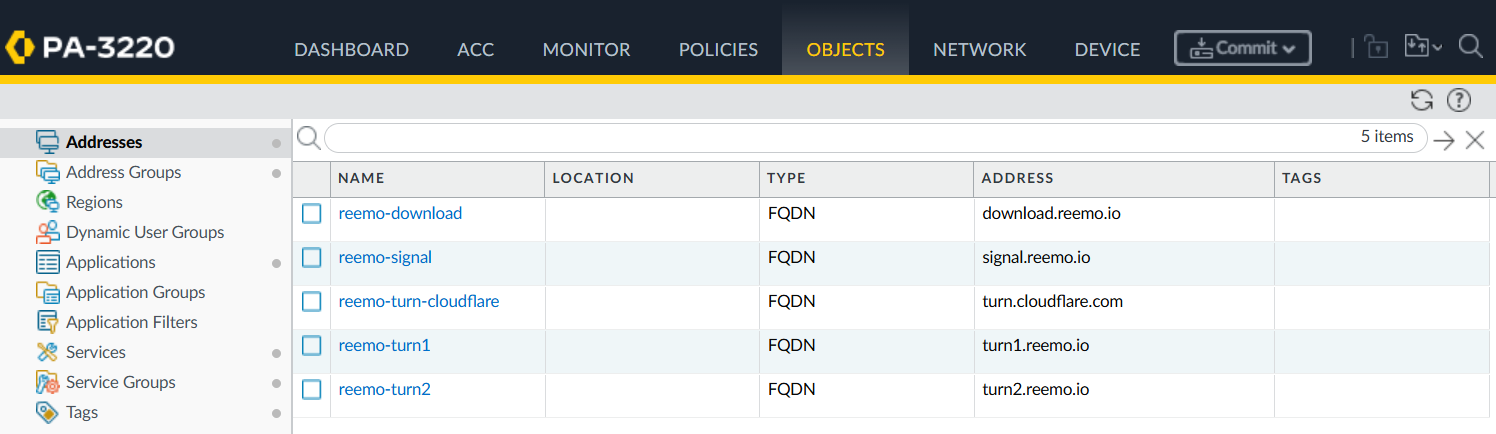
Reemo addresses configured in Objects > Addresses.
Then group them in Objects > Address Groups:
reemo-cloud: groups the 5 addresses above.
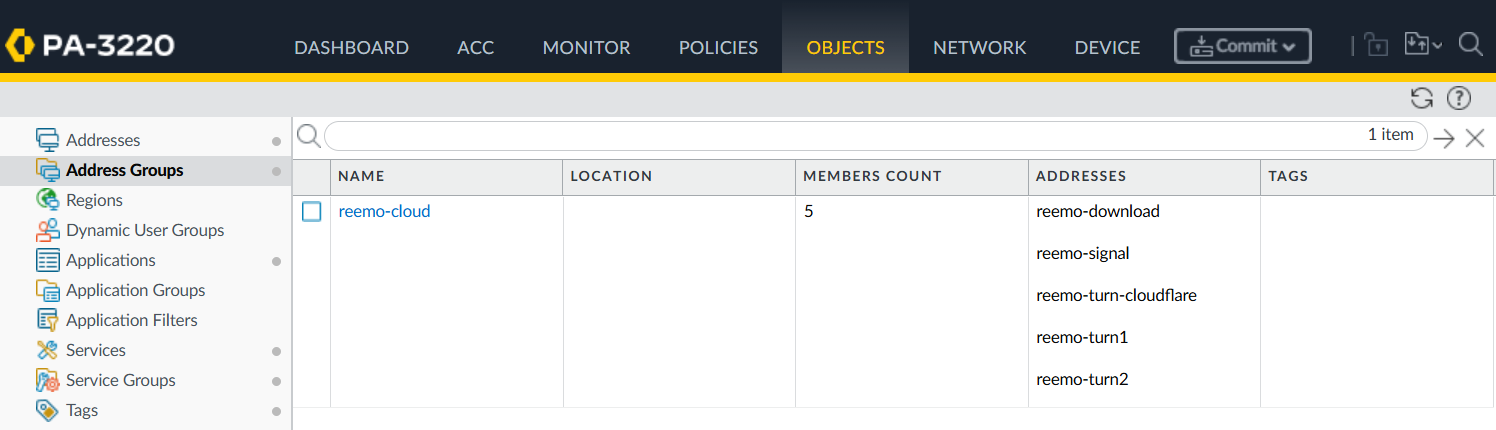
reemo-cloud address group, grouping the 5 Reemo addresses.
Step 2: Add the required services
In Objects > Services, add:
reemo-turn-tcp-3478: Protocol
TCP, Destination Port3478reemo-turn-udp-3478: Protocol
UDP, Destination Port3478reemo-turn-udp-443: Protocol
UDP, Destination Port443reemo-media-udp: Protocol
UDP, Destination Port1024-65535, Source Port58200-58400
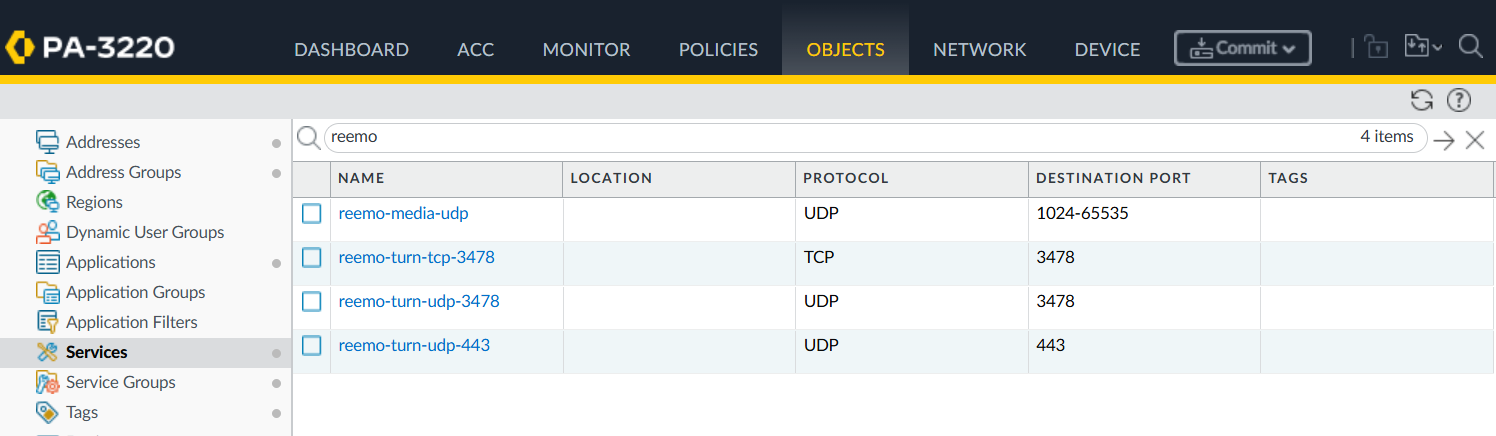
Reemo services configured in Objects > Services.
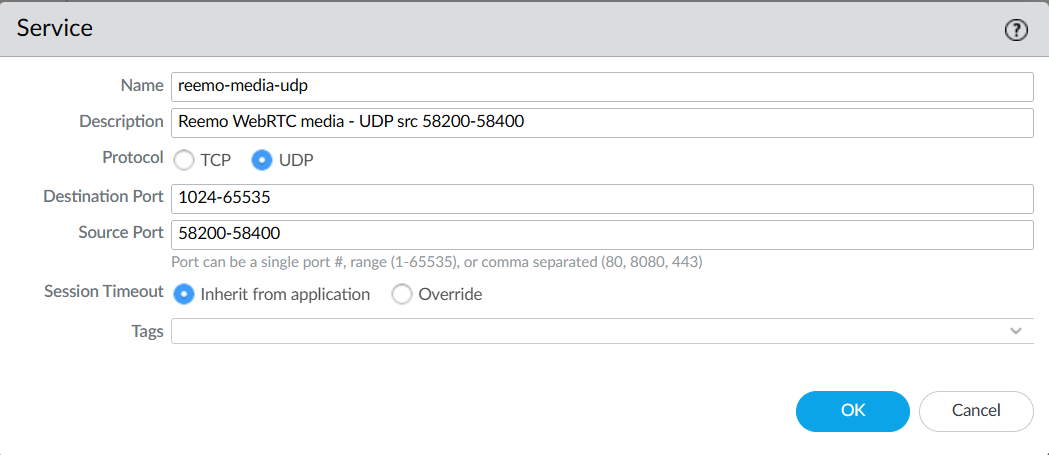
Detail of the reemo-media-udp service (WebRTC port range).
Note
The wide range (1024-65535) is required by WebRTC to establish peer-to-peer connections. Traffic remains end-to-end encrypted and restricted to Reemo communications.
Group the signaling services in Objects > Service Groups:
reemo-signaling: groups
reemo-turn-tcp-3478,reemo-turn-udp-3478,reemo-turn-udp-443and the predefinedservice-httpsservice.
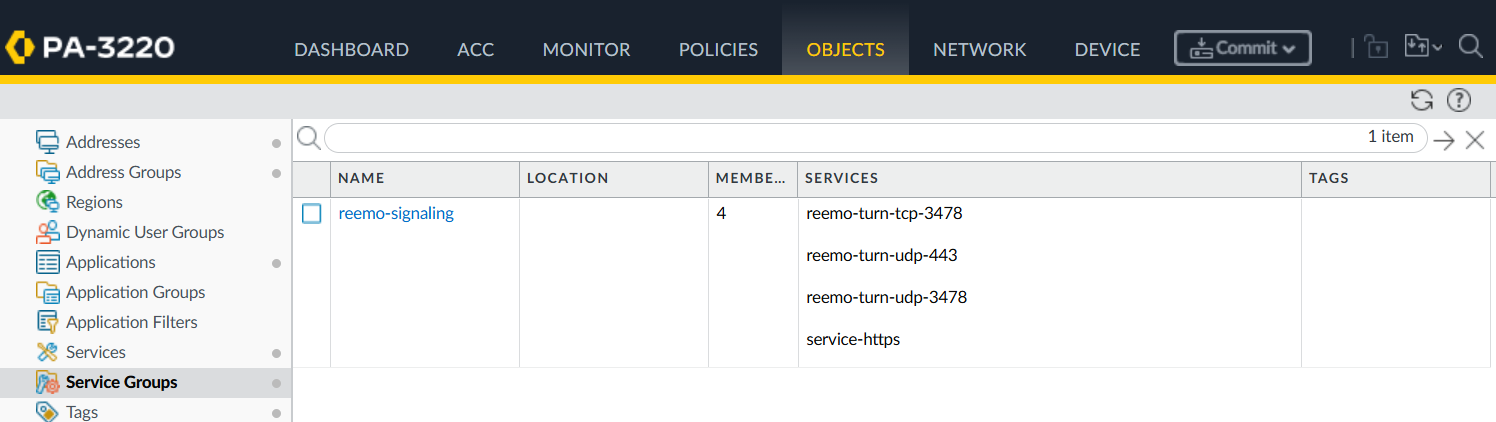
reemo-signaling service group.
Step 3: Create the security rules
In Policies > Security, add these two rules:
- Reemo-Signaling-TURN:
Source Zone:
trustDestination Zone:
untrustDestination Address:
reemo-cloudService:
reemo-signalingAction:
Allow
- Reemo-Media-P2P:
Source Zone:
trustDestination Zone:
untrustDestination Address:
anyService:
reemo-media-udpAction:
Allow
Note
The Reemo-Media-P2P rule targets any as the destination: the peer-to-peer WebRTC connection can reach a browser located anywhere on the internet, not just the Reemo infrastructure.
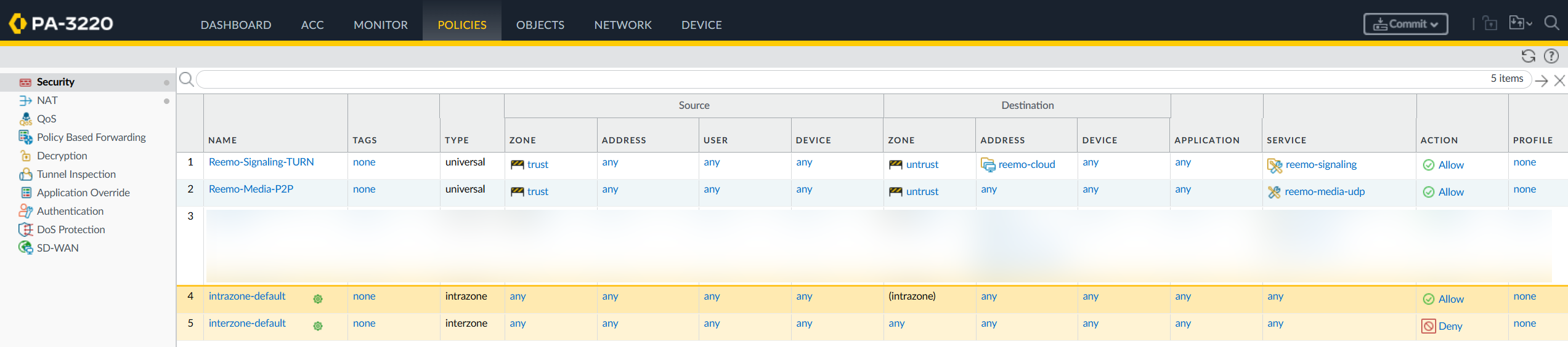
Overview of the configured security rules.
Step 4: Configure NAT
In Policies > NAT, add a source NAT rule for outgoing traffic:
- LAN-Source-NAT:
Source Zone:
trustDestination Zone:
untrustSource Address: your internal subnet (e.g.
192.168.50.0/24, adjust as needed)Translated Packet > Source Translation: see below (depends on your PAN-OS version)

Overview of the configured NAT rule on PAN-OS earlier than 11.1.
Note
For WebRTC sessions to remain stable behind this dynamic translation, the firewall must keep the same IP/port mapping for a given source (Persistent DIPP). Which translation type to select depends on your PAN-OS version:
PAN-OS earlier than 11.1: select
Dynamic IP and Port, then enable the persistent behavior globally on the firewall, in Device > Setup > Session (Session Settings), or via CLI:set system setting persistent-dipp enable yes.PAN-OS 11.1 and later: select
Persistent Dynamic IP and Portdirectly as the translation type — no additional global setting is needed.
Warning
In both cases, restarting the firewall is mandatory for the change to take effect.
Summary: Ports and addresses to open
Usage |
Protocol |
Ports |
Destination |
|---|---|---|---|
Signal server |
TCP |
443 |
|
TURN servers |
TCP/UDP |
3478, UDP 443 |
|
Download server |
TCP |
443 |
|
Reemo Media (P2P) |
UDP |
1024–65535 (src 58200–58400) |
|