Mouse & Keyboard
The Mouse/Keyboard tab of the Settings panel adjusts input modes and keyboard behavior.
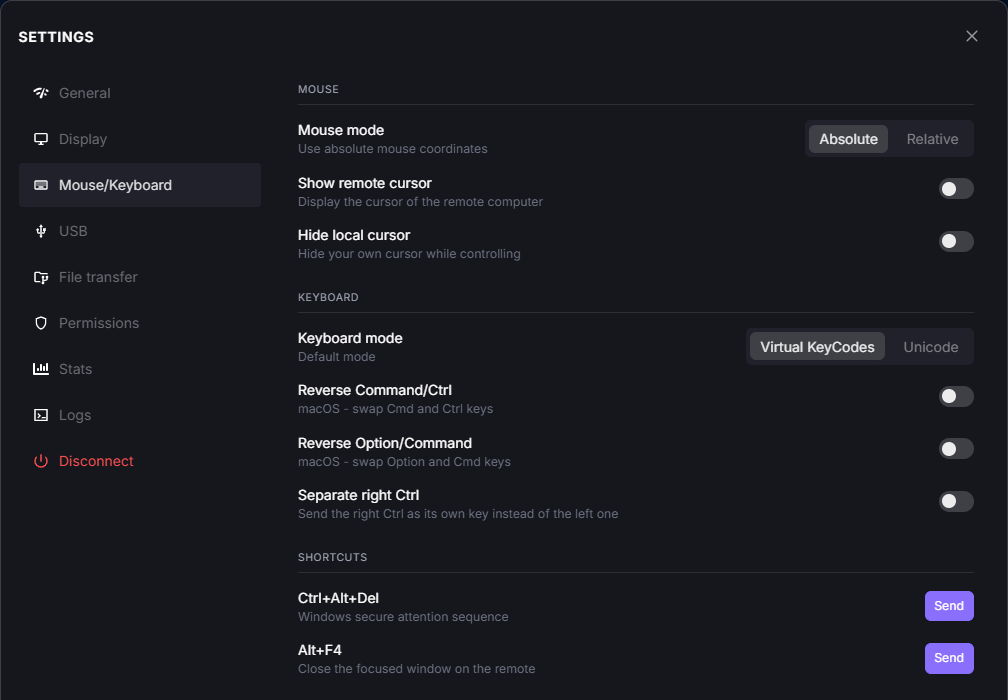
Settings panel, Mouse/Keyboard tab.
Mouse
Mouse Mode
Absolute: uses the absolute coordinates of the mouse. Provides better precision during movements and is recommended for most standard uses.
Relative: uses the relative movements of the mouse (instead of position). Designed for video games, especially FPS, where continuous and fluid movements are essential.
Show Remote Cursor
Displays the remote computer’s cursor. Particularly useful when multiple people are on the same machine: without this option, the remote user cannot see the local user’s cursor.
Hide Local Cursor
Hides your local cursor (to be used together with Show Remote Cursor). Particularly useful for graphic tablet users to counter latency: only the real position of the remote cursor is shown, not the slightly delayed local one.
Important
If you are connected to a Windows machine and cannot see the cursor, it means no mouse is physically connected to the PC. To fix this issue, either plug in a mouse or enable Mouse Keys in Windows (Settings > Accessibility > Mouse > Mouse keys).
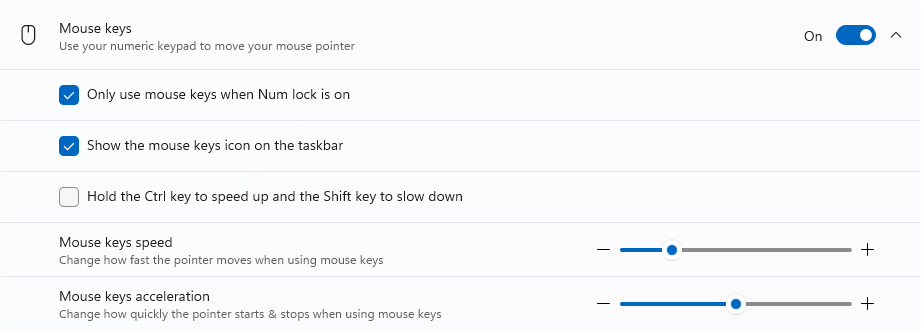
Enabling Mouse Keys in Windows.
Keyboard
Keyboard Mode
- Virtual KeyCodes (default): Sends the physical key code (its position on the keyboard).
- Example: if your local keyboard is AZERTY and the remote machine is QWERTY, pressing the A key locally will send a Q to the remote machine.This mode is useful if you want to reproduce the physical layout of your keyboard, regardless of the language or remote mapping.
- Unicode: Sends the Unicode character corresponding to the pressed key directly.
- Example: typing A on an AZERTY keyboard will send an A, even if the remote machine is configured as QWERTY.This mode is particularly useful when keyboard layouts differ (AZERTY ↔ QWERTY, or other non-standard layouts), or when using keyboards with specific system differences (Windows ↔ macOS, custom keyboards, etc.).
Warning
Reverse Command/Ctrl
macOS only. Swaps the behavior of the Command (⌘) and Control (Ctrl) keys when using a macOS keyboard connected to a remote machine. Useful to avoid confusion between macOS and Windows keyboard shortcuts.
Reverse Option/Command
macOS only. Swaps the behavior of the Option (⌥) and Command (⌘) keys when using a macOS keyboard connected to a remote machine.
Separate Right Ctrl
When enabled, the right Ctrl key is sent to the remote machine as its own key, instead of being treated the same as the left Ctrl key. Useful for applications or shortcuts that distinguish between the two.
Separate Right Alt (AltGr)
When enabled, the right Alt key is sent to the remote machine as its own key instead of the left one. Layouts that use it as AltGr, such as French AZERTY, can then type their extra characters.
Release All Keys
Click Release to lift every key and modifier still held down on the remote machine, for example a stuck Ctrl, Alt or Shift. Use it for troubleshooting when the remote machine behaves as if a key were still pressed. Pin it with its star to keep it one click away in the toolbar (see Pinning Favorites to the Toolbar).
Shortcuts
Send a system shortcut to the remote machine with one click. The buttons that appear depend on the operating system of the remote machine. Each shortcut has a star: click it to pin the shortcut to the toolbar (see Pinning Favorites to the Toolbar). Custom shortcuts, which you define yourself, are covered in Shortcuts.
Ctrl+Alt+Del (Windows machines only)
Windows security shortcut. Click Send to send the Ctrl+Alt+Del combination to the remote machine, for example to open Task Manager or the Windows security screen.
Windows intercepts this system shortcut on the local computer before it reaches the remote machine, which is why Reemo provides a button for it. The button appears only for Windows remote machines, because this shortcut does not exist on Linux and macOS.
Alt+F4 (not available on macOS machines)
Click Send to close the focused window on the remote machine. The button does not appear for macOS remote machines, where this shortcut does not exist.
Back to the Settings panel overview.